Yiwu Market: How to Find a Supplier, and How to Tell If They Actually Make Anything
The pants hanging outside are not what that shop makes
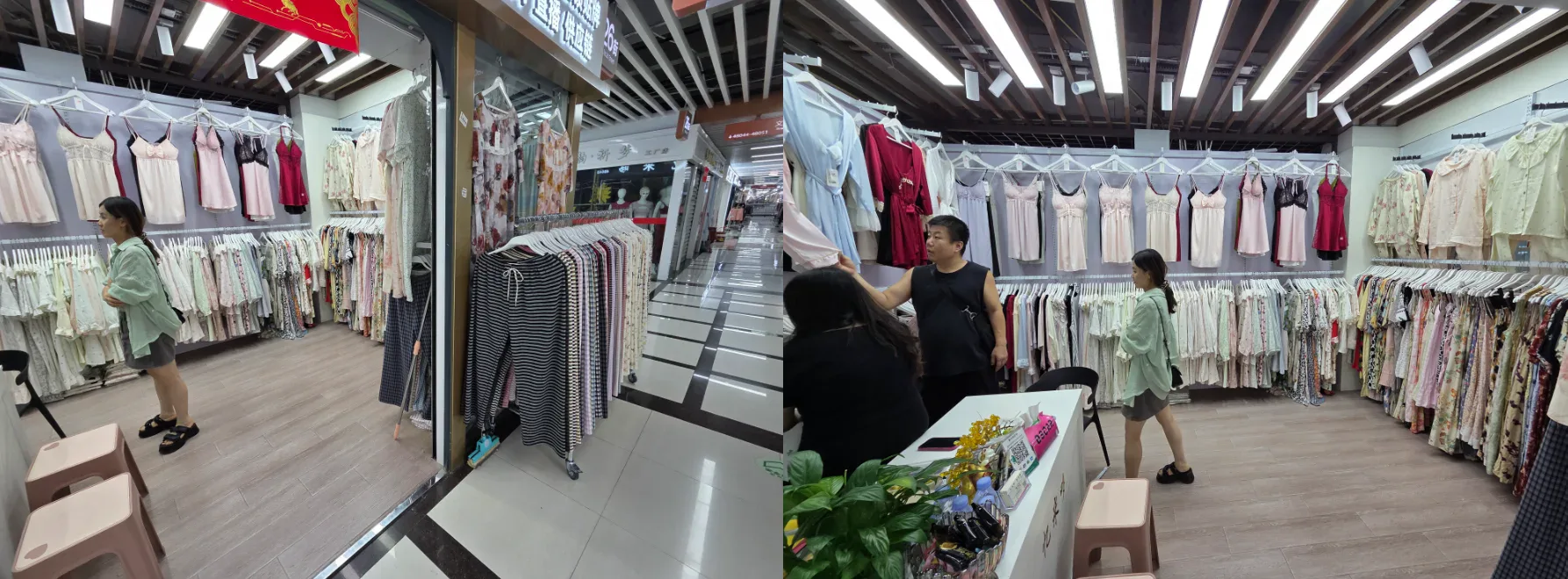
Walk down any garment aisle in Yiwu and you will see racks like this outside the booths. Pants, dresses, whatever is moving that season.
Now look inside the same booth.
Pajamas and sleepwear. That is what this shop actually specializes in. The rack outside is there to catch a passing buyer.
This is the single most important thing to understand about Yiwu Market, and almost nobody explains it to first-time buyers. Every booth has one thing it is genuinely good at, and the front display does not always tell you what that thing is. If you walk up and ask a sleepwear specialist to quote you pants, they will quote you. The price will be worse and the quality will be worse, because they are buying it from somewhere else and adding a margin.
I will come back to this. First, how to find your way around.
What Yiwu Market is
Yiwu Market, officially Yiwu International Trade City, is the world's largest wholesale market for small commodities. It sits in the Futian area of Yiwu, Zhejiang Province, and holds more than 75,000 supplier booths across six districts.
I work here. My office and warehouse are in this city and I walk this market most weeks. Every photo in this article was taken by me on a normal working afternoon. Nothing here is stock photography.
A Yiwu address has five parts
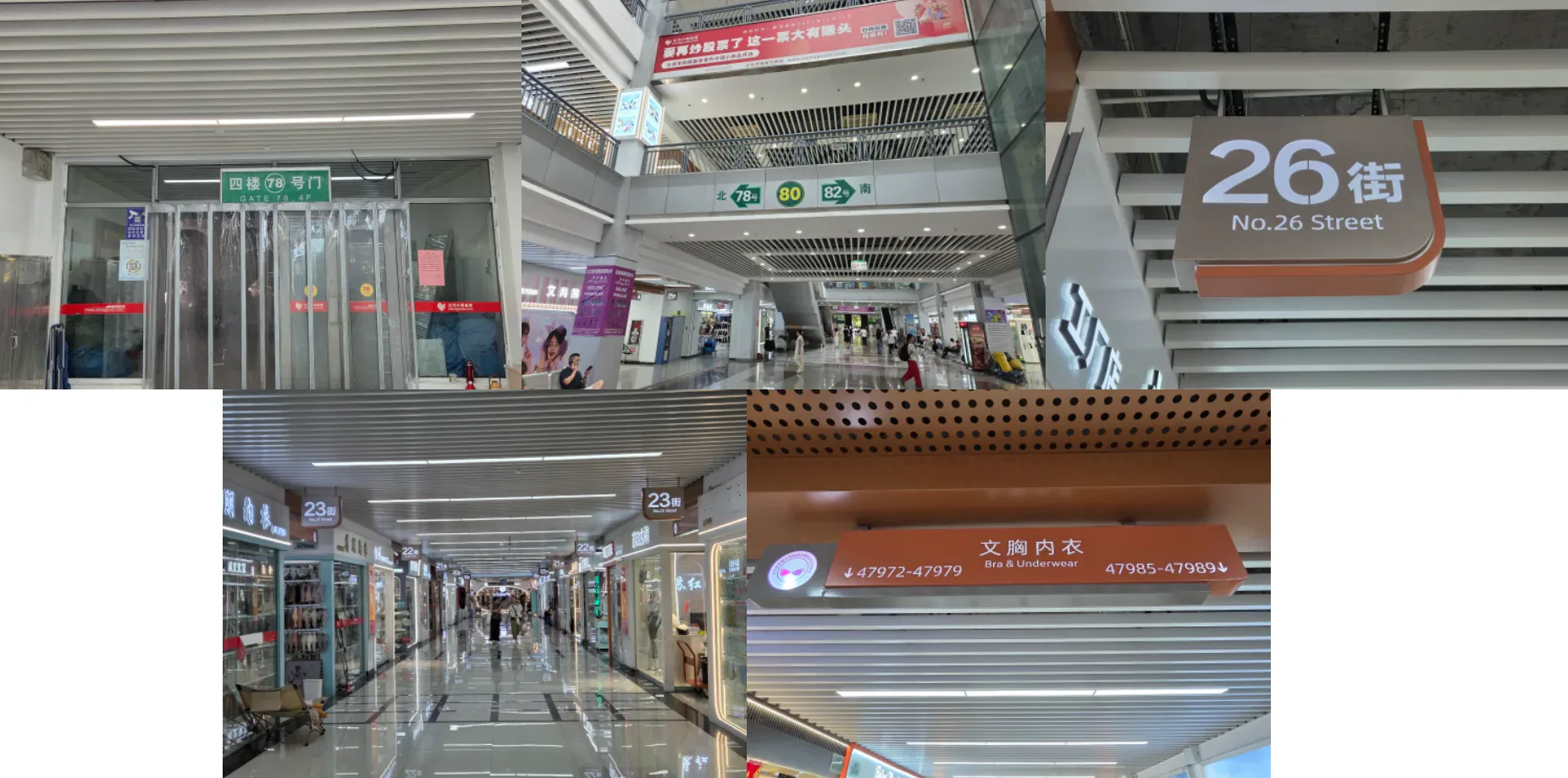
To find a supplier again, you need five things: district, gate, floor, street, and booth number.
Most guides only give you the district. The district is the least useful part.
District, Gate, Floor, Street, Booth number
- The market is split into six districts, numbered 1 through 6. This is the broadest level.
- Each district has numbered gates. This is the part that saves you time, and it is the part nobody writes about. Once you have visited a supplier once, you only need to remember the gate number. You do not need to remember which district it was in. Go to that gate, walk in, and you are already in the right corner of the right building.
- Categories are stacked by floor. Different floors of the same district hold completely different products.
- Every floor is cut into numbered streets running front to back. The signs hang over the aisles.
- The last coordinate. Booth numbers run in blocks by category, so the number itself already hints at what is inside.
- Almost every supplier will hand you a business card with the complete address printed on it. Photograph the card. Photograph the booth plate next to the product. A phone number and a sample are not enough to find a shop again, and I have watched buyers lose a supplier they liked exactly that way.
The overhead signs at each junction carry street numbers and category icons in both directions. Once you can read these, the building stops being a maze.
What is in each district
District 1 - Toys, plush toys, artificial flowers, jewelry, hair accessories, crafts, holiday decorations.
District 2 - Bags and suitcases, umbrellas and rainwear, hardware and tools, kitchenware, small appliances, clocks, lighting, electronics.
District 3 - Eyewear, pens and paper, office and stationery, sports and outdoor, cosmetics and beauty, zippers, buttons and apparel trims.
District 4 - Clothing, socks, hats, gloves, shoes, belts, scarves, towels, underwear, daily necessities.
District 5 - Imported goods, bedding, curtains, fabrics and textile raw materials, auto and motorcycle accessories.
District 6 - The newest district, part of the Yiwu Global Digital Trade Center: fashion jewelry and trendy toys, apparel fabrics, skincare and baby products, household and travel goods, drones, robotics and AI equipment, smart tech.
More than 75,000 booths, and very few of them are factories
Here is a question worth sitting with. If Yiwu Market has over 75,000 booths, how many of those are factories?
Not many. It cannot work any other way. China is large, but no country has 75,000 factories parked inside one set of buildings, and Futian is only one of many markets like it across China. Most booths are trading companies. Some are one step from the factory. Some are three steps.
That is not a scandal. Traders serve a real purpose, and a good trader with the right factory behind them can beat a mediocre factory direct. But you need to know which one you are talking to, because it changes everything about the order.
There is no trick question that gets you a straight answer. You work it out by talking about the product in technical detail and watching how they respond, and that is a feel you build over many visits rather than something you can read in an article, including this one. What matters here is simply knowing the question exists. Most first-time buyers assume every booth is a factory, ...because the booth never says otherwise.
The same question applies online, where you cannot see the booth at all. I wrote separately about what an unusually low listing price is usually hiding.
Why this matters more for OEM than for ODM
If you are buying ODM, specialization matters less
ODM means you take a product the supplier already makes and change surface details: your color, your label, your packaging. The design and the pattern already exist. You are mainly comparing price and quality on something already made. A trader can handle this well.
If you are buying OEM, specialization is the whole game
OEM means the product is built to your spec, from your drawing or your sample. Now you need the people who actually run the machines for that product. A sleepwear booth taking on your pants order will subcontract it, and you will lose control of fit, fabric and timing without ever being told.
So before you ask for a quote, work out what that booth is really for. Look past the rack outside. Look at what fills the back wall and what is stacked in the corners. That is the specialty.
The market at 1:30 in the afternoon
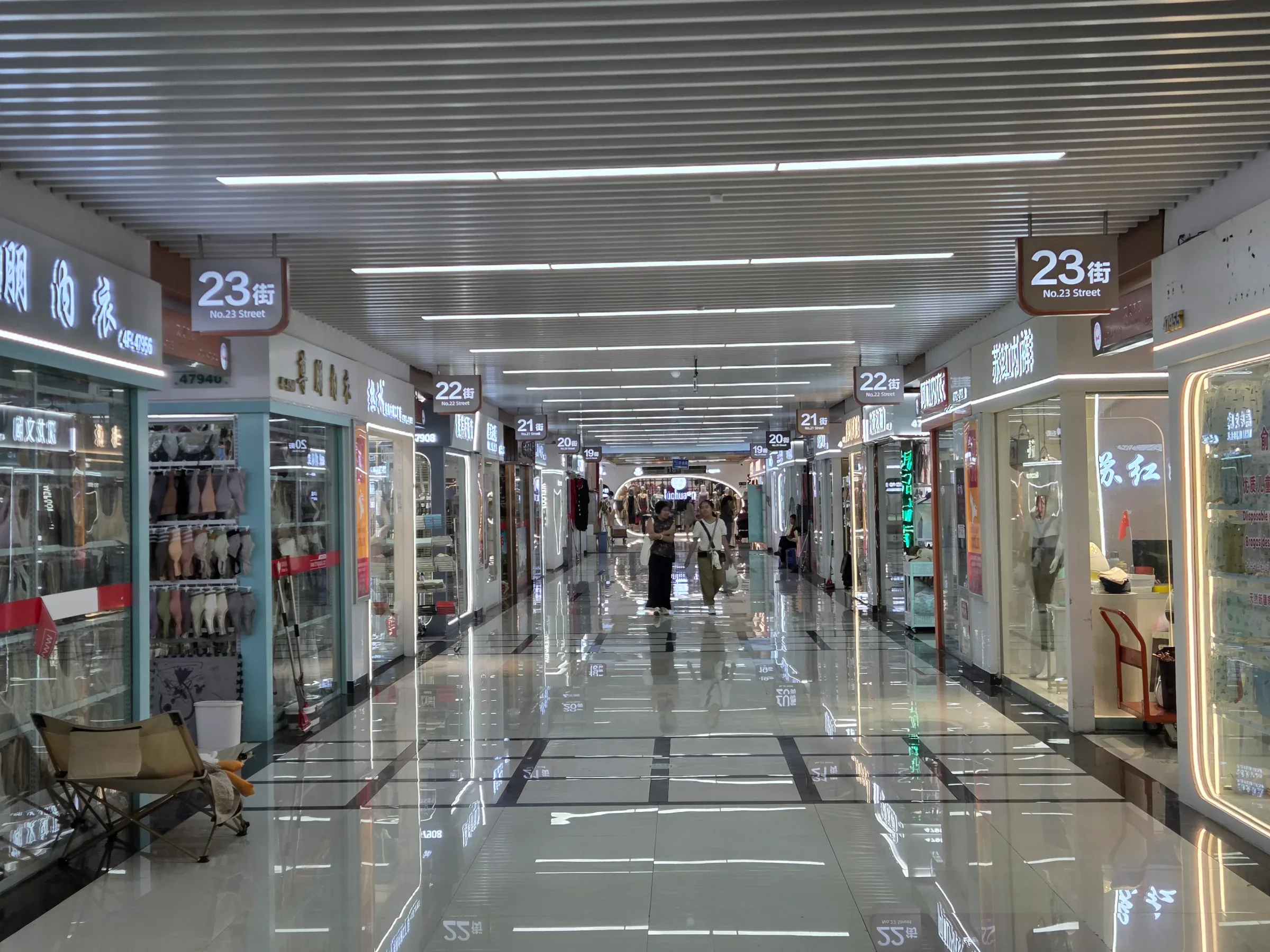
This is what people are not shown. Yiwu is described as the busiest market on earth, and in the morning that is fair. By early afternoon on an ordinary weekday, whole aisles look like this.
That is useful, not disappointing. An empty aisle means the supplier has time to sit down with you. Look at the booth photos again and you will see a table and chairs in almost every one.
A booth is not a shop. It is a meeting room with samples on the wall.
Buyers who treat it like a retail store walk through, look and leave. Buyers who sit down get prices.
If the booth is open but nobody is there, walk on
You will find booths that are open, lit, fully stocked, and empty. No staff.
Do not call the number on the card and wait. Do not stand there for twenty minutes. Move to the next booth, and come back another day if the product really matters to you.
Why the shutter is open
Futian market fines a booth for not opening. So when the owner cannot be there, they ask the neighbour to open the shutter for them. The booth is open because of the rule, not because anyone is working it.
The reason that actually matters
If the person is not at the booth, they are usually at the factory. That means production is heavy right now. A supplier buried in this season's orders is not going to give your new product real attention, and often will not say so directly. They will take the order, and you will feel it later, in the sampling delays and in the quality.
An empty booth is information. Read it and keep walking.
How I actually walk the market
I do not walk the whole market. Nobody can. A photographer who spent four days here told CNN he still would not say he got near seeing all the booths.
- Decide the product before you arrive. Not the category, the product. "Underwear" is not enough. "A women's seamless brief, cotton and spandex, five colors" is enough.
- Pick one floor and finish it. Moving between districts costs an hour each time. Every photo in this article came from a single walk.
- First pass, no talking. Walk the aisle once and collect only photos and booth numbers. That pass shows you the price range, the quality range, and who the serious suppliers are. Then go back to the three or four booths worth a real conversation.
- Record the full address every time. District, gate, floor, street, booth.
- Talk in the afternoon. Mornings are for walking and collecting. Afternoons are for sitting down.
From a booth to actual production
What you see in a booth is stock: a finished item with someone else's design, someone else's packaging, often someone else's brand. You can buy it as it is, and for a test order that is a reasonable choice.
But if you want your own label, your own color, your own size chart or your own box, the booth is the beginning of the process, not the end.
Three things a booth will rarely tell you clearly:
- The real minimum quantity for a change. Buying 200 pieces as they are and making 200 pieces in your color are not the same order.
- Whether the fabric can actually be swapped. Sometimes it can. Sometimes the answer is yes, and then bulk arrives in the original fabric.
- Who is actually making it.
None of this makes Yiwu a bad place to source. ... and production starts after that. Here is what that production actually looks like, from the sample we cut a hole in to the bales that ship.
Practical notes for a visit
Hours
The market generally runs from 9:00 to 5:00. Plan your real work inside that window, because the useful part is shorter than the official one. From around 3:00 in the afternoon the market starts emptying out. Suppliers pack up, staff leave, and the odds of the person you need still being at the booth drop fast.
Do not stay too late
Yiwu traffic is heavy at the end of the day. If you leave the market at closing time you can lose a long stretch of your evening sitting in it. I aim to be done and moving before the rush.
Chinese New Year
The one time the market fully closes, for roughly two weeks. Do not plan a trip around it. Suppliers are also slow for one to two weeks either side, because factory workers travel home.
Best months
March to May, and September to November.
Sundays
The buildings are open but fewer suppliers show up. Fine for orientation, poor for negotiation.
Frequently asked questions
Do I need a ticket to enter Yiwu Market?
No. Entry is free. You pay for goods, not access.
What time should I arrive?
Get there in the morning. The market runs to 5:00 but empties from around 3:00, so treat the afternoon as your last working hour rather than half a day.
How many days do I need?
For one product category, two full days. For three or more, plan four. Anyone who says they can cover the market in a day is selling you a taxi ride.
Is a booth the same as a factory?
Usually not. With more than 75,000 booths in the market, most are trading companies. Ask directly, and ask to visit the factory.
Why is a booth open with nobody in it?
Because the market fines shops for not opening, so a neighbour opens the shutter. The owner is usually at the factory. Come back another day rather than waiting.
Can I buy small quantities?
Usually yes. Minimums in Yiwu are low compared with most of China, which suits buyers testing a new product. Minimums rise the moment you ask for changes.
What is the difference between OEM and ODM here?
ODM means changing surface details on a product the supplier already makes. OEM means building to your own spec. ODM is mostly a price comparison. OEM depends on finding a supplier who genuinely makes that product.
If you are planning a trip
I am based in Yiwu. I source fabric, manage production at factories here, and ship finished goods to buyers in Korea, the United States and Europe. If you are coming to walk the market, or if you already know your product and want it made rather than bought off a shelf, you can reach me here.
